
AI agent instead of a chatbot: how to stop losing leads on your site
Your chatbot still makes customers press buttons? In 2025 that’s burning money. Learn how a smart AI agent replaces the sales team and works 24/7.
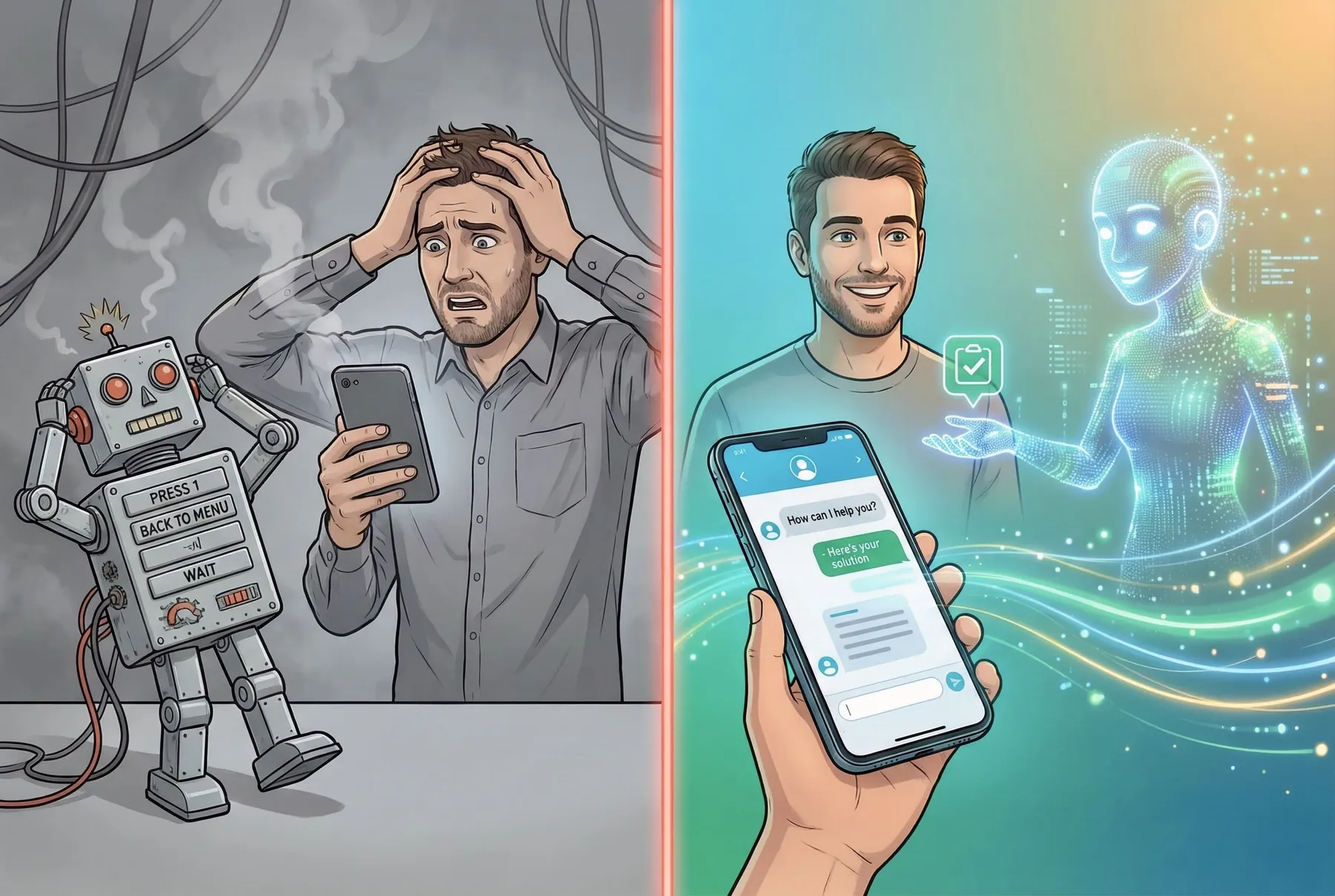
AI agent instead of a chatbot: how to stop losing leads on your site
Imagine you’re spending hundreds of thousands on ads. A customer sees the ad, gets excited, goes to the site… and hits a wall.
In the corner a chat pops up: “Hello! Press 1 to check order status. Press 2 to call an operator…”
The magic is gone. In a “dopamine economy” where speed is the new currency, nobody wants to talk to a dumb robot. If service isn’t instant and human, the customer closes the tab in 3 seconds. They go to a competitor who will actually talk.
In 2025 the era of button “auto-responders” is over. AI agents replaced them. Here’s why it’s time to fire the old bot and hire a digital employee.
Why old bots kill sales
Most companies still use rigid “constructor” scripts. It’s like talking to someone blind:
- Step left/right = error. The bot understands only the exact phrases hardcoded into it. Slightly different wording — and it freezes.
- Waste of time. The customer wants to ask: “Can you deliver to Queens tomorrow?” — and gets a menu. That’s annoying.
- Outcome: Budget drain. You paid to bring the customer, but at the entrance they meet an incompetent doorman.
Solution: smart AI agent (your best employee)
At RM Ecosystem we think differently. We don’t put bots “for show.” We build full-fledged digital employees integrated into the business core.
How does an Agent differ from a regular bot? Think calculator vs. live accountant.
1. It truly knows your business (RAG)
Main fear: “What if the model lies to clients?” Pure ChatGPT can. Our Agents run on RAG (Retrieval-Augmented Generation).
Plain meaning: The agent works like a perfect librarian. Before answering, in fractions of a second it “reads” your instructions, price lists, and SOPs.
- It knows everything about your product.
- It never invents facts.
- It relies only on your business documents.
2. Faster than thought
While a human rep sips coffee or types, the Agent has already replied. Response time — 0.1–0.3 seconds. Faster than a blink. That speed feels like care and professionalism.
3. 24/7 lead qualification
The agent doesn’t sleep, get sick, go on vacation, or have mood swings. It speaks natural, human language. It asks budget, clarifies details, finds the pain, and passes a ready, “warm” lead to the manager.
Care economics: less cost, more profit
Rolling out an AI agent isn’t an expense; it’s an investment with instant payback.
- Lower CAC. The agent captures attention and drives the goal cheaper than any human rep.
- No routine. Your managers stop answering “Where are you located?” and “How much is it?”. Let humans handle complex deals; let the robot take the repetitive load.
- Scale. Want to sell abroad? The agent instantly switches to English, Spanish, or Chinese. You enter global markets without translators.
Your business in your pocket
The nicest part for the owner is controllability. With the Agent you get the business “nervous system” right in Telegram. All analytics, dialogs, content management — at your fingertips. You see the pulse of the company in real time.
Main takeaway
Stop “renting” other people’s tools and relying on constructors. Build your own Digital Asset.
Your knowledge base and your AI agent are the company’s capitalization that belongs to you. While competitors fiddle with buttons, you get a system that works faster, smarter, and cares about every client.
What to do right now? Visit your site as a normal visitor. Ask the chat a question. If you have to wait or press buttons — you’re losing money right now.